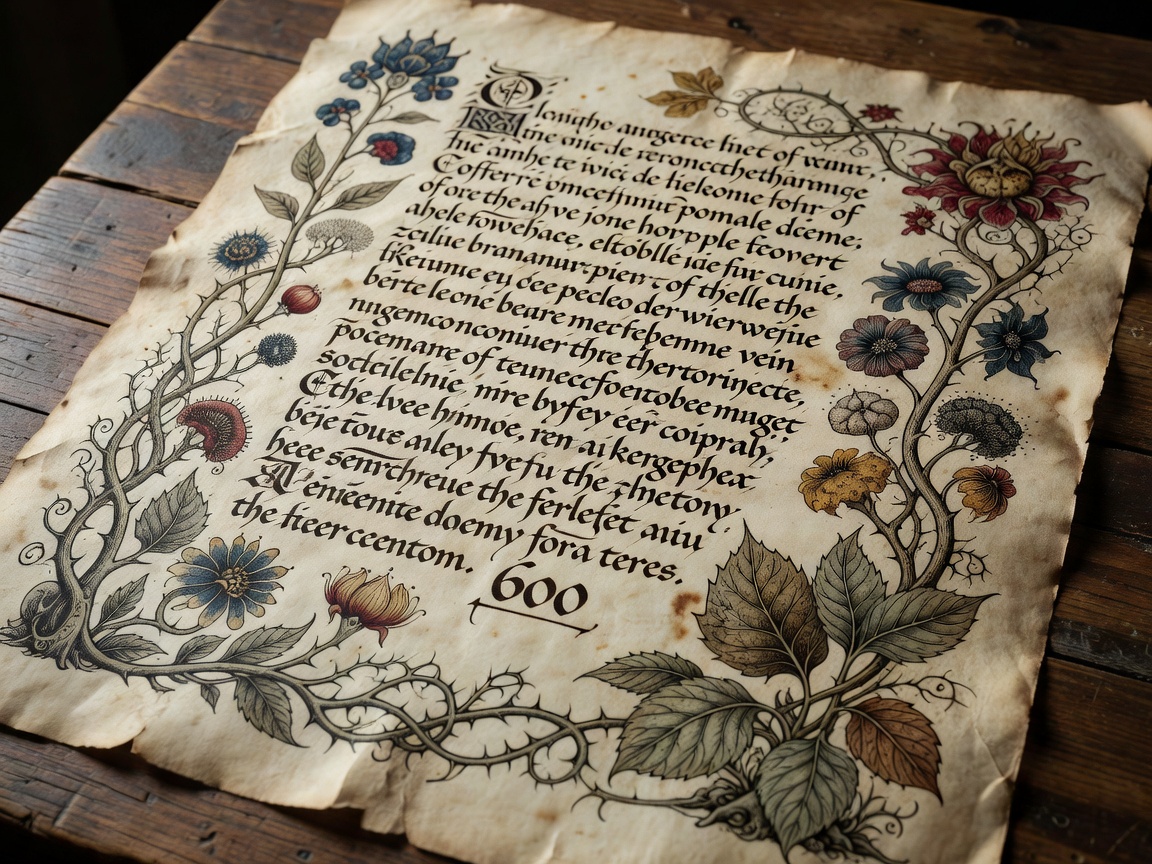
The Voynich Manuscript, catalogued formally as MS 408 at Yale University's Beinecke Rare Book and Manuscript Library, represents one of the most resilient cryptological puzzles in recorded human history. Dating conclusively from radiocarbon analysis of its vellum to the early 15th century (roughly between 1404 and 1438), the 240-page manuscript is written in an unknown script with an untranslatable linguistic structure.
Codex Anatomy & Categorisation
The codex is richly illustrated with vibrant, albeit biologically anomalous, botanical drawings, astronomical diagrams, intricate astrological charts, and biological sequences showing miniature female figures in complex plumbing or tube-like systems. Scholars commonly divide the manuscript into distinct thematic sections based on the illustrative contents:
- Herbal Section: Contains 113 folios depicting unidentifiable plant specimens, combining roots, leaves, and blooms from disparate real-world botanical families.
- Astronomical & Astrological: Features circular diagrams displaying zodiac symbols, radiating star charts, and sun-moon representations.
- Balneological / Biological: Illustrates nude figures submerged in liquid chambers linked by interconnected conduit networks.
- Cosmological: Folds out into expansive multi-page diagrammatic maps, including the nine-medallion rosettes folio.
- Pharmaceutical: Displays drawings of plant parts alongside pharmacy-style jars and vials.
- Recipes / Text-only: Short paragraphs marked with star-shaped bullet points, potentially recording medical formulas or alchemical preparations.
Cryptanalytic & Statistical Characteristics
Unlike simple substitution ciphers or arbitrary artistic doodles, the text of the Voynich manuscript—often termed "Voynichese"—exhibits rigorous statistical regularities that mirror natural spoken languages. The text follows Zipf's Law, meaning the frequency of any given word is inversely proportional to its rank in the frequency table.
Furthermore, the word entropy matches that of Romance and Germanic languages. Yet, anomalies persist: repetitive token sequences (words appearing twice or three times consecutively) are vastly higher than in natural European vernaculars, while character transitions reveal a rigid internal grammar that precludes random glyph spamming.
| Attribute | Verified Specification | Analytical Significance |
|---|---|---|
| Physical Material | Calfskin Vellum (240 surviving pages) | Uniform medieval origin; no modern paper layers detected |
| Radiocarbon Age | 1404–1438 CE (95% confidence) | Pre-dates Renaissance cryptography advances |
| Character Set | 20 to 25 distinct core glyphs | Matches size of typical western and middle-eastern alphabets |
| Binding Status | Altered in 17th & 20th centuries | Original folio sequencing partially disordered |
Hypotheses Under Consideration
1. Natural Unknown Language
This hypothesis posits that the text is a phonetically transcribed natural dialect—perhaps an extinct Sino-Tibetan language, early Turkic dialect, or proto-Romance variant written in a tailor-made alphabet. While grammar regularities support this, the lack of cognates and unusual prefix-suffix distribution remain unresolved.
2. Sophisticated Polyalphabetic Cipher
Proponents suggest an early cryptographer utilised an algorithmic method, such as a Cardan grille or early substitution matrix, to encrypt a known language like Latin or High German. However, 15th-century cryptanalysis standards rarely produced texts of such statistical consistency without human error breaks.
3. Medieval Artificial Construct / Glossolalia
A minority position argues the manuscript is an elaborate medieval hoax or the product of glossolalia (speaking in tongues) authored by an ascetic monk or alchemist seeking patron funding from nobility like Holy Roman Emperor Rudolf II. Yet the investment in expensive vellum for a non-functional document makes pure artifice debatable.
Conclusion & Modern Research Paths
With high-resolution digital imaging and modern natural language processing neural networks applied to the corpus, the Voynich Manuscript remains a benchmark test for computational linguistics. Until an undiscovered bilingual document or cryptographic key surfaces, MS 408 retains its impenetrable mystery.