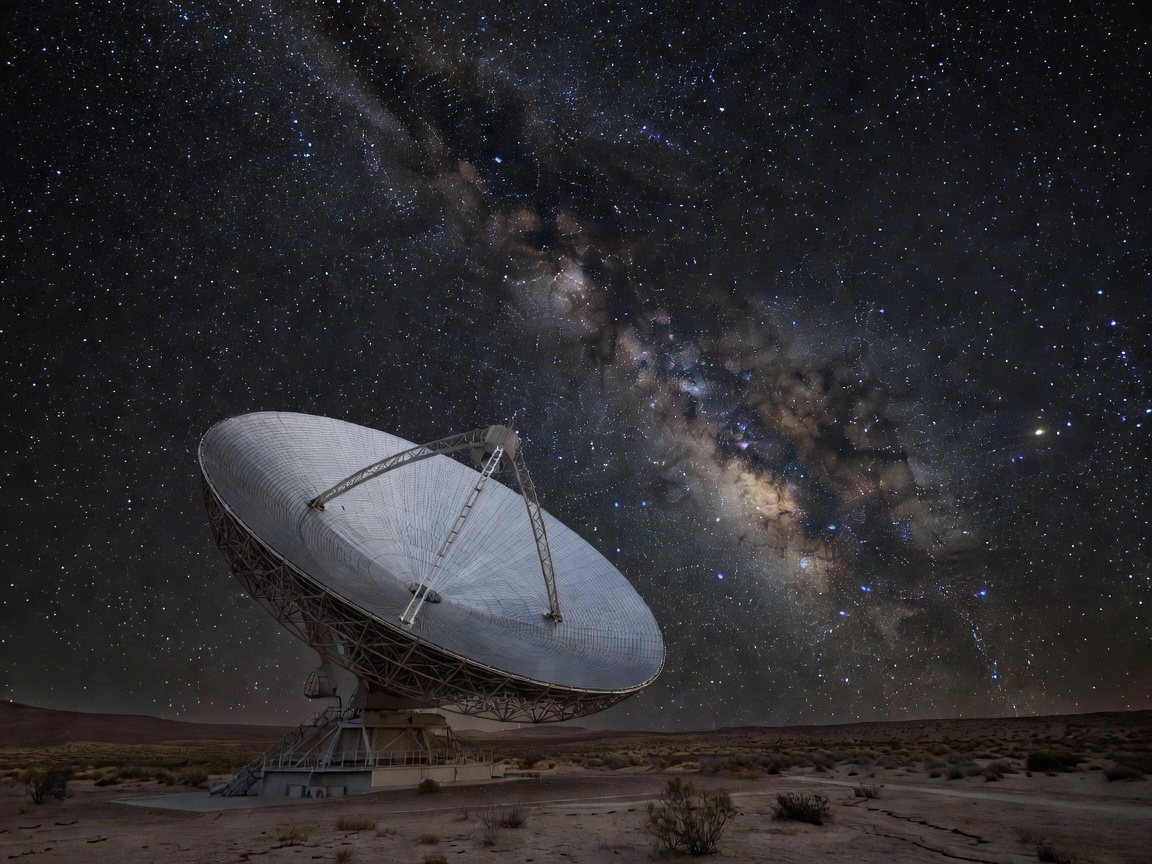
On August 15, 1977, the Ohio State University's "Big Ear" radio observatory recorded an extraordinarily intense, narrowband radio burst while conducting routine SETI (Search for Extraterrestrial Intelligence) sky sweeps. Astronomer Jerry R. Ehman, reviewing the computer printout days later, famously circled the alphanumeric sequence 6EQUJ5 in red ink and wrote "Wow!" alongside it.
Deciphering the 6EQUJ5 Alphanumeric Sequence
The code represents the signal-to-noise intensity across consecutive 12-second integration intervals on a 10 kHz channel. In the IBM 1130 system utilised by Big Ear, digits 1 through 9 represented baseline signal multipliers, followed by letters A through Z for higher intensities:
- 6: Signal intensity 6 to 7 sigma above background noise.
- E: 14 to 15 sigma.
- Q: 26 to 27 sigma.
- U: 30 to 31 sigma (Peak signal strength, over 30 times baseline noise).
- J: 19 to 20 sigma.
- 5: 5 to 6 sigma.
The overall 72-second duration precisely matched the telescope's antenna beam pattern as Earth's rotation swept the stationary horn across that coordinate in the constellation Sagittarius.
| Parameter | Measured Value | Scientific Implication |
|---|---|---|
| Frequency | 1420.4556 MHz (or 1420.356 MHz) | Matches the 21-centimetre Neutral Hydrogen Line, the "water hole" frequency. |
| Bandwidth | Less than 10 kHz | Natural astronomical emitters typically produce broadband noise, not ultranarrow bands. |
| Duration | 72 seconds | Consistent with a point source originating outside the Earth's orbital reference. |
| Sky Coordinates | RA: 19h22m24s or 19h25m24s (Dec: -27°03′) | Located near Chi Sagittarii; no solar system planets or satellites were in the beam. |
Hypotheses & Evaluation
1. Extraterrestrial Technosignature
The signal matches every theoretical expectation for an interstellar beacon: narrowband emission at the protected hydrogen frequency, clear Doppler profile, and high signal-to-noise ratio. However, scientific standard requires replication. Despite thousands of hours of observation by the Very Large Array (VLA) and Breakthrough Listen targeting the same coordinates, the signal has never recurred.
2. Comet Cloud Laser (Maser) Phenomenon
In the late 2010s, a hypothesis suggested that comets 266P/Christensen or P/2008 Y2 were passing near the coordinates, causing transient hydrogen cloud fluorescence. However, subsequent radio telescope measurements of passing comets failed to demonstrate the tight bandwidth or intensity profile detected in 1977.
3. Terrestrial Reflection / Military RFI
Scattering of a secret ground-based radar transmission by space debris could theoretically replicate a 72-second sweep. Yet the 1420 MHz band is strictly forbidden globally for terrestrial transmissions under international telecommunications treaties to protect radio astronomy.
Current Scientific Consensus
The Wow! Signal remains classified as an unresolved astronomical anomaly. While it fits the parameters of an artificial non-terrestrial broadcast, the inability to verify or replicate the event leaves it as the most compelling yet tantalising data point in the history of radio astronomy.